Today’s story is called The Bald Wife, and is also from the Folk-Tales of Bengal, by the Rev. Lal Behari Day. This story is meant to remind, like many other stories, that being a good person can get you everything, while being a bad person will get you nothing.
Reading Notes
- A man had two wives, and favored the younger one (who had two tufts of hair) more than the older one (who had only one tuft of hair).
- As such, the younger wife abused her sister-wife regularly, since the man would go out of town to do business.
- One day, the younger wife demanded the older wife search her head for lice; while the older wife was doing this, one of the younger wife’s tufts of hair came out by chance.
- The younger wife, very angry, pulled out the older wife’s one tuft of hair and drove her away.
- Now totally bald, the older wife decided to walk into the forest and either be eaten by an animal or die of starvation.
- As she walked, she walked by a cotton plant, a plantain tree, a bull in a shed, and a tulasi plant.
- Each time, she swept the area around them clean with a broom she made from sticks, and was blessed in return.
- Eventually she came upon a hut where a muni (a holy person) was meditating.
- Upon being questioned by the muni, the older wife told him everything that had happened to her.
- The muni told her to go to a tank of water and bath herself in it only once.
- The older wife did as she was instructed, and emerged from the water with floor length black hair and looking young and beautiful.
- She went back and gave her thanks to the muni, who told her to go into the hut and take one of the wicker baskets in there; the older wife did, and selected a plain one.
- The muni told her to open the basket, and in it were many precious stones of various types; the muni told her the basket would refill itself with more stones every time it emptied, and sent her on her way.
- As she walked back home, she passed each of the creatures she had previously cleansed and shown respect to.
- Each one, as she passed by, gave her a gift:
- The tulasi plant blessed her with her husband’s love, the bull blessed her with shells that would help her obtain whatever ornament she wanted, the plantain tree blessed her with a leaf that would help her get food, and the cotton plant blessed her with a branch that would produce all kinds of fabric.
- Upon her return, the younger wife was shocked to see that the old bald hag had turned into a beautiful young woman.
- Although the older wife treated the younger wife with great kindness, the younger wife was bitter of her sister-wife’s looks.
- When she learned that the older wife’s looks came from the muni, the younger wife set off immediately to find his hut.
- She followed the same path as the older wife, but passed by the cotton plant, the plantain tree, the bull, and the tulasi plant without any kind of acknowledgement.
- The younger wife came to the muni’s hut, and he told her the same thing he had told the older wife.
- The younger wife bathed herself once, and was beautiful with a full head of hair, but she decided a second bath would make herself even more beautiful.
- Instead, she emerged looking exactly as she had before bathing herself.
- When she went crying to the muni, he drove her away, chastising her for her greed.
- She went back to the house; when their husband came home, he paid attention only to his beautiful older wife and all her wealth and resources, while the younger wife was kept as a maid.
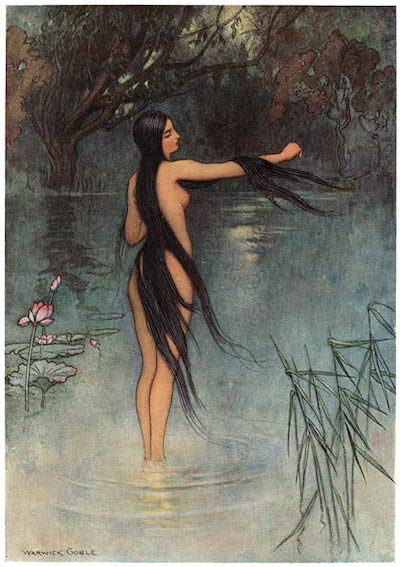
The elder wife bathing and becoming beautiful (Souce)