Showing posts with label Feedback. Show all posts

Wednesday, March 6, 2019

Week 8 Feedback/Comments Reflection

Feedback is such a fun thing. Sometimes. Not really. But it is necessary, especially in a writing-based class. That being said, giving feedback can be good, in the long run. Overall, I do enjoy the feedback I’ve been getting from my classmates. Especially when my grammar errors are pointed out to me. 

As far as giving feedback, sometimes I do struggle to come up with enough to talk about, but the feedback techniques do help. Hopefully the feedback that I do leave is helpful for people! I tend to focus more on grammatical stuff than writing things, I think. Consistently writing comments/feedback that meets the word quote is pretty hard for me, I think because I end up struggling with not sounding repetitive. Dividing it up over the week would help, but that means not procrastinating, and as I’ve established that’s hard for me.

In the future I think I’ll try to do more blog feedbacks. Going through intros and not sounding repetitive is difficult for me, but I think spreading it out over the week will make it easier. Something to try out anyway. 
Sunday, February 3, 2019

Thoughts on Feedback Strategies

In an online class I took a few years back, I remember that we had to go through and read someone’s response to something, and respond back, but we couldn’t talk about the same thing that someone else had already mentioned. So if I wanted to talk about the person’s thoughts on a matter, but someone else already had, then I was SOL. Giving feedback when you’re restricted in that manner is hard. 

That being said, feedback is generally pretty helpful (unless someone is being negative just because they want to be). When looking at the articles to read from, one of the ones I was drawn to was Deborah Maue’s article on giving creative feedback when you’re not creative. I don’t consider myself to be a particularly creative person; I’m a great consumer of arts (books, media, etc), but actually creating something is pretty hard for me, and not something I can do easily. Give me a structure to work with though, and I can go from there. This is precisely what the article does: it gives a structure to follow to help you organize and come up with constructive criticism. 

Another article that I liked was How to Give Feedback without Sounding Like a Jerk, by Adam Grant. When he asked colleagues for advice on giving feedback to an older CEO, a lot of them told him to do it like a sandwich: start and end with positive feedback, and put the negative feedback in the middle. But this isn’t really effective. For one thing, it can seem condescending to the receiver. And people tend to remember the beginning and end of a conversation anyway, not the middle (this is true for anything, actually: lists, conversations, etc). So the negative feedback might be forgotten. Adam instead proposed that it was best to explain why you’re giving the feedback, make sure that you’re perceived to be on the same level as the recipient (make this seem like a conversation between equals, not information being handed down), and making sure the person wants to hear the feedback.

So, all in all, while feedback is important, presenting it properly can be difficult. In this class, since all the feedback is going to be presented in text, there are some things that’ll need to be taken into consideration, but the principles from these two articles will be much the same. Hopefully I’ll be able to improve my feedback strategies overall, not just for this class.

To be fair, cats can't read, so they don't know properly ways to give feedback. Source

Sunday, January 27, 2019

Week 2: Thoughts on Feedback

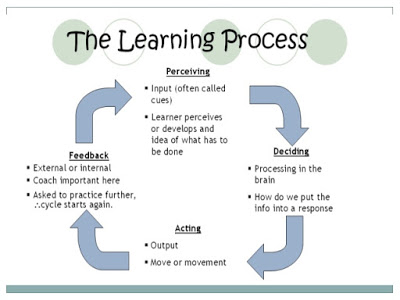
In looking over the articles for the assignment, a few stood out to me. One of them was the graph for the Learning Process.

From the article

As we can see, learning is a continuous process, not a simple “A to B” trip. In our brains, as I’ve learned in my psychology classes, information is constantly being edited and refined with new information (or even with processing it after the fact). This is why your memory of an event may change over time, or, in relation to the current topic, how you view something may change over time.

Another article that I liked was the essay by John Cleese, titled “The Importance of Mistakes.” Cleese discusses how it’s important to recognize that, as long as someone reaches the end goal in the right amount of time, then the amount of mistakes they make along the way shouldn’t matter. Little mistakes are easily correctable, and having these small mistakes happen means that the goal is reached in the end. This rang a bell for me, since I’m encountering something similar at work. I was moved to start working in the accounting office, and my philosophy has become, “As long as I don’t make the same mistake twice, then I’m doing okay.” There’s a lot that goes into working in the office, and I’m the only one in there during my shift. Most of the time I end up texting one of my coworkers with a question, but I feel that as long as I don’t make the same mistake twice, then that means I am learning, and will eventually get to the point where I can reach the end goals without any help. 

This is something that can apply to life in general too. As long as I keep learning from my mistakes and avoid repeating them, then my end goal will be reached in the end.

But this is also me after 15 minutes of homework (Source: Growth Mindset Blog)